Turn your feedback into decisions—with a team of experts behind you.

Point a general-purpose AI at your feedback and it will summarise it—but it can't design a survey that withstands legal challenge, find the real driver behind a falling NPS, or model which customers are about to leave. That's the hard part, and it's where general-purpose tools stop. Our Nerd-assisted consultancy puts behavioural scientists, statisticians and analysts alongside your team—co-designing how your feedback is classified, training it to your sector, and turning it into decisions you can defend.

Wordnerds experts working alongside a customer team on their feedback framework
What we do

What our consultants do

Wordnerds consultants offer six core services—survey and consultation design, root-cause analysis, attitudinal and motivational segmentation, behavioural science, predictive modelling, and bespoke one-off analysis—available with the Wordnerds platform behind them or entirely on their own.

  • Survey & consultation design

    Statistically robust, bias-free questionnaires for customer surveys and public consultations—built to withstand audit and legal challenge.

  • Root-cause analysis

    Finding the factors that actually drive your NPS, CSAT and complaint volumes—not just measuring the score.

  • Attitudinal & motivational segmentation

    The old way segments by demographics and behaviour. We add attitudinal and motivational segmentation—grouping customers by what drives them, not just who they are.

  • Behavioural science

    Understanding what actually changes customer behaviour—working with behavioural psychologists, not just tracking satisfaction scores.

  • Predictive modelling

    Bespoke models that read incoming feedback to flag the customers most likely to leave—before they do.

  • Bespoke one-off analysis

    A single hard question answered end to end: arrive with the problem, leave with the decision.

It's software and a service—working as one

Wordnerds consultancy isn't a standalone service; it's the team that makes our platform deliver. Most engagements bring in the Wordnerds platform to do the heavy processing—classifying feedback at scale and keeping the intelligence flowing into the Microsoft Power BI your teams already use. Some don't need it at all. Sometimes a single hard question is the whole job.

Some providers sell you software and wish you luck. Others do the analysis but lock it inside their own platform. Wordnerds joins the two: our experts design the method and shape the delivery, and the Wordnerds platform makes it repeatable—so the intelligence keeps flowing long after the first project, without anyone rebuilding it. For most customers the platform is the engine that does the actual processing; the consultancy is what points it at the right problem and makes the output land.

But it isn't all-or-nothing. Plenty of projects never touch a dashboard—a one-off analysis, a survey designed from scratch, a model built for a single decision. You take exactly as much of the platform as the job needs, and the same experts run it either way.

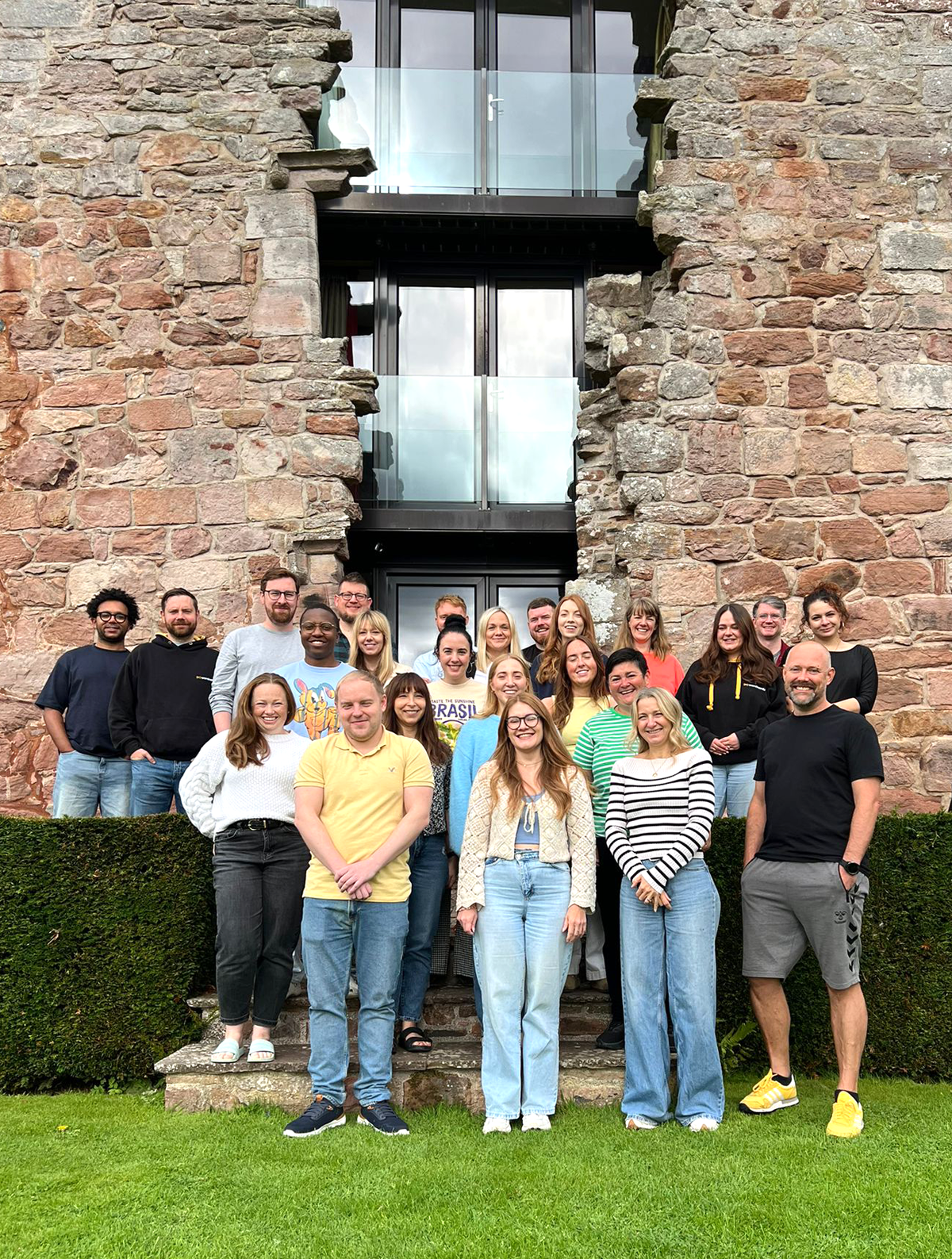
The Wordnerds team—the analysts, data scientists and behavioural scientists you'd work with on a consultancy project—together outside the office
Beyond the platform

Expertise you can hire on its own

Yes—Wordnerds takes on one-off, commissioned consultancy projects, not just ongoing platform work. They're specialist pieces of analysis: bias-free survey design built to withstand legal challenge, behavioural-science studies, bespoke predictive models. We agree deliverables, costs and timescales up front, and the platform only comes in if the job needs it.

Some of the work never touches a dashboard—a survey designed from scratch, a model built for a single decision. Pure analytical and behavioural-science expertise, hired to answer one hard question. Two of the standalone projects we've taken on:

Public consultation that stands up to challenge

The North East Combined Authority brought us in to design the surveys behind a series of public consultations—decisions big enough to be challenged in court. We wrote questions free from leading bias, with a methodology built to hold up if anyone argued it was steering the result. And we worked with behavioural psychologists to understand what would actually change how people behave, not just what they say in the moment.

Predicting which customers are about to leave

For one of the UK's largest high-street banks, we built bespoke prediction models that read incoming complaints and flag the customers most likely to leave. It turns a backlog of grievances into an early-warning system the retention team can act on—reaching the customer before they walk, not reading about it after.

Can't we just build this ourselves with AI?

You can get part of the way with an AI model and a BI tool—plenty of capable teams do. The gap is everything after the first draft: a classification you can trust at scale, the method to turn it into decisions, and the cost of keeping it all running. That's what a team of experts brings, and what building alone rarely reaches.

It's never been easier to build something yourself—which is exactly the trap. The proof-of-concept comes together in a weekend; then someone has to keep it alive. Teams are quietly creating full-time jobs maintaining the tools they vibe-coded—tweaking prompts, patching features, re-running models that burn through tokens on every large dataset, and rebuilding software that already exists off the shelf. The real bill, the total cost of ownership, lands long after the demo and never stops.

And there's a quieter trap. A tool gets bought, a dashboard gets built, and then it sits there, because no one owned the job of turning it into action. Either way you end up in the same place: data you have, insight you don't.

Summarising isn't classifying—and classifying is only the start

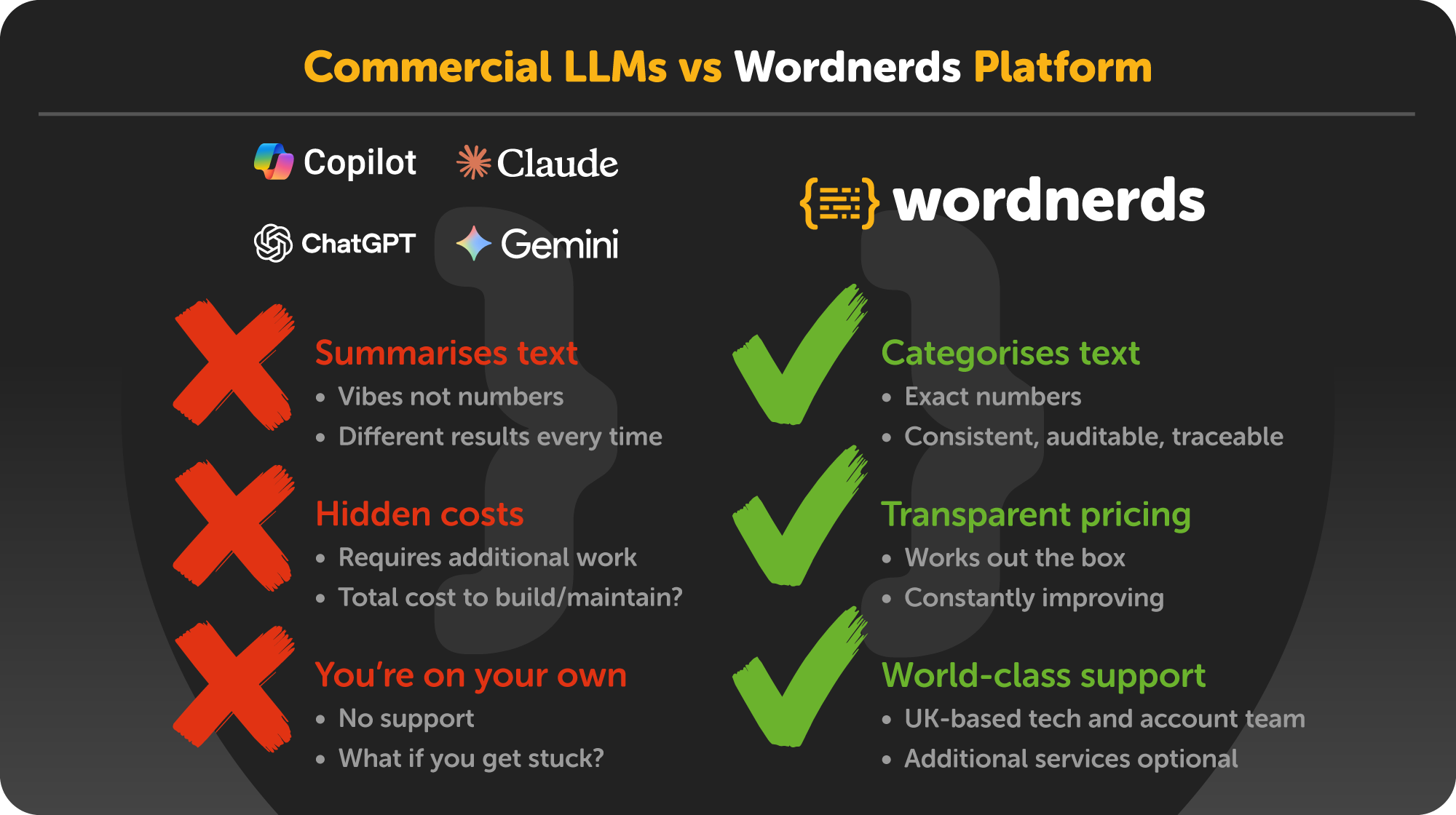
A general-purpose AI summarises feedback; it doesn't classify it. Classifying means every comment sorted the same way every time, auditable and traceable to source—at a scale that gets expensive fast on raw AI. And classification is only the start: the real value is the analytical method that turns structured data into decisions.

Comparison: commercial LLMs (Copilot, Claude, ChatGPT, Gemini) only summarise text—vibes not numbers, different results every time, hidden build and maintenance costs, and no support—while the Wordnerds platform categorises text into exact, consistent, auditable numbers, with transparent pricing and a UK-based support team
A general-purpose LLM summarises; the Wordnerds platform categorises—with transparent pricing and a support team behind it.

Point an AI model at raw feedback and you get a summary that sounds right and changes every time you ask. Wordnerds classifies instead: an automated model sorts every response against a framework your team has authored and signed off—the same way every time, each theme tracing back to what a customer actually said. Run that at scale on raw AI and the token costs climb quickly, and only get steeper as your volumes grow.

Even then, classification is only the start. The value our experts add is method built over years of doing this: attitudinal and motivational segmentation that groups customers by how they feel and what's driving them, root-cause analysis that explains why a score moved rather than just that it did, and linking themes to the KPIs your business actually runs on. Behavioural science—hygiene factors versus motivators—separates what merely stops complaints from what earns loyalty; and we design and read the data to control for bias and to model where it's heading. None of that comes out of a prompt.

How a consultancy project runs

A consultancy project is a one-off piece of commissioned work: you arrive with a specific problem—usually non-standard or complex, and outside the skill set of the people you have in-house. It's the work that calls for specialist analysis, data science, data engineering, behavioural science or deep voice-of-customer expertise. We agree the deliverables, costs and timescales up front, like any other piece of work—then we run it like this:

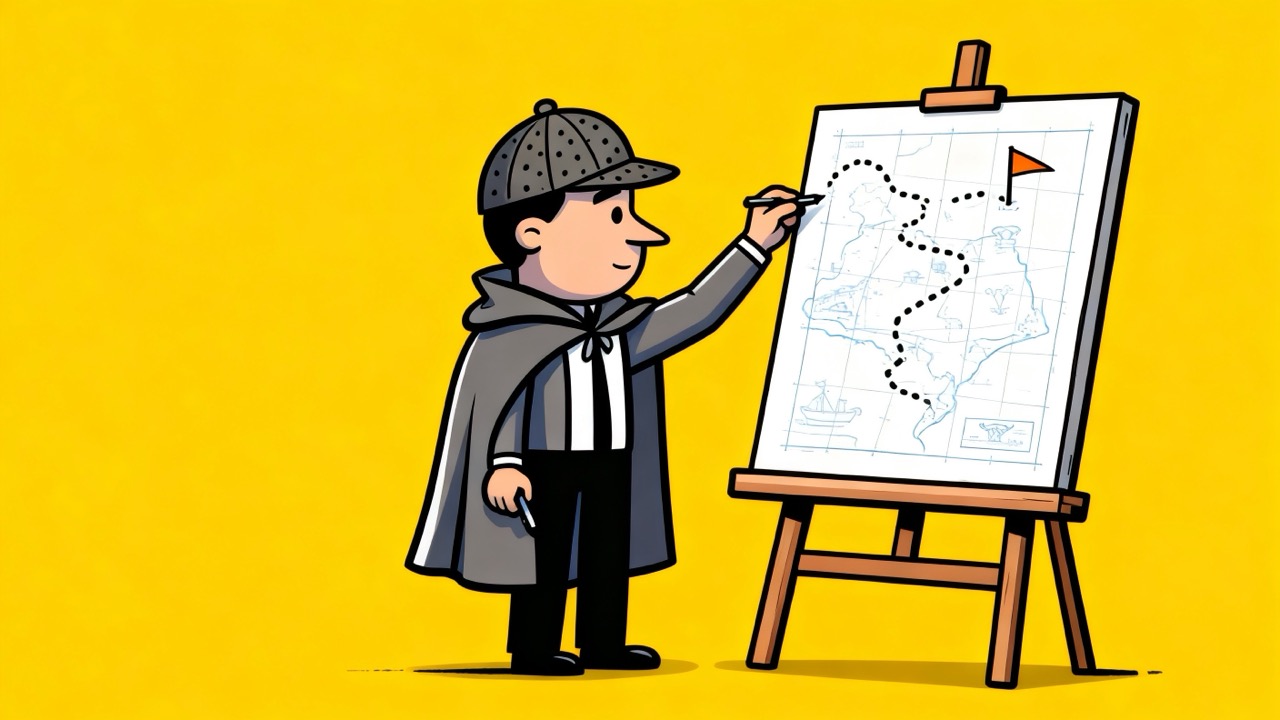
A Wordnerds expert and a customer team mapping the objective behind the project

Discovery

We start with the question behind the question—your objective, your sector, and the way your customers and teams actually talk. No two engagements start the same way, so we map what good looks like before we build anything.

Designing the engagement plan and a framework chosen for the customer's sector and goal

Project design

We design the engagement around that objective: the right frameworks and methodologies for your sector and goal, the channels in scope, and a delivery plan with clear, short iteration cycles. You know what you're getting, and when.

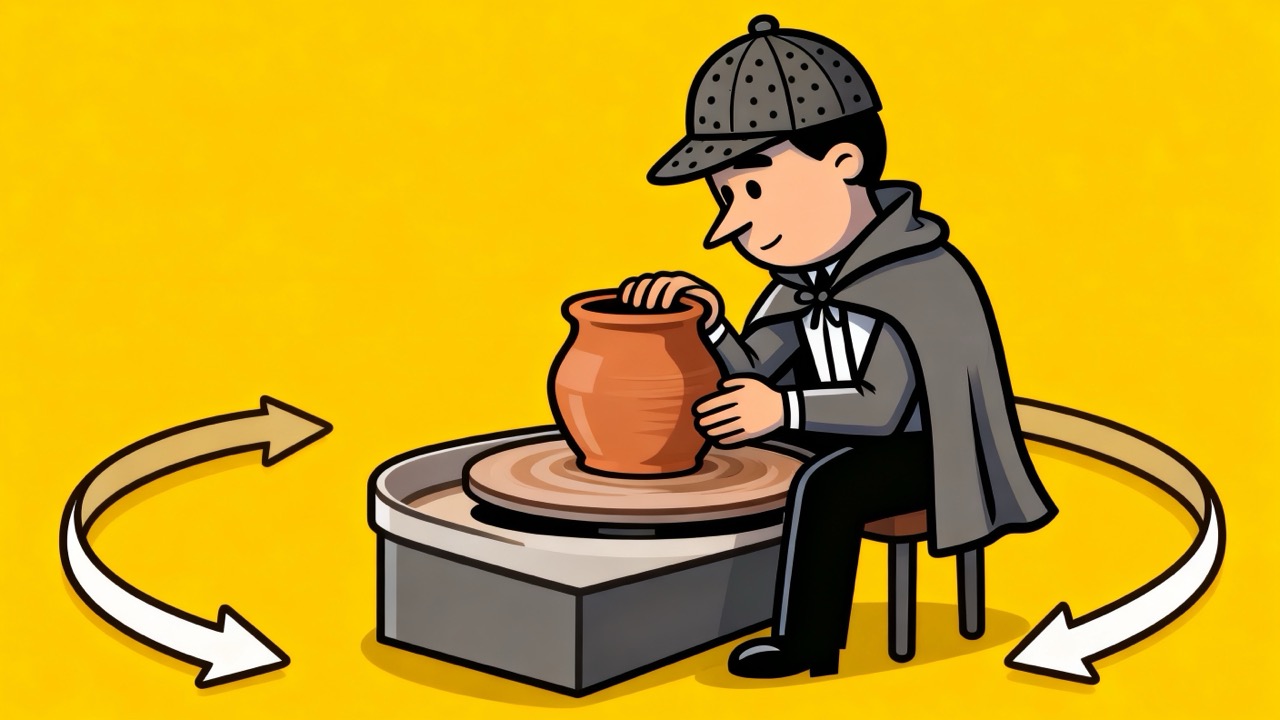
Rapid, AI-driven prototype iterations refined with the customer in short cycles

Agile delivery

Because our product and methods are AI-driven, we build a working prototype fast and refine it with you in short cycles—you see real output in days, steer it, and watch it sharpen, instead of waiting months for a big reveal.

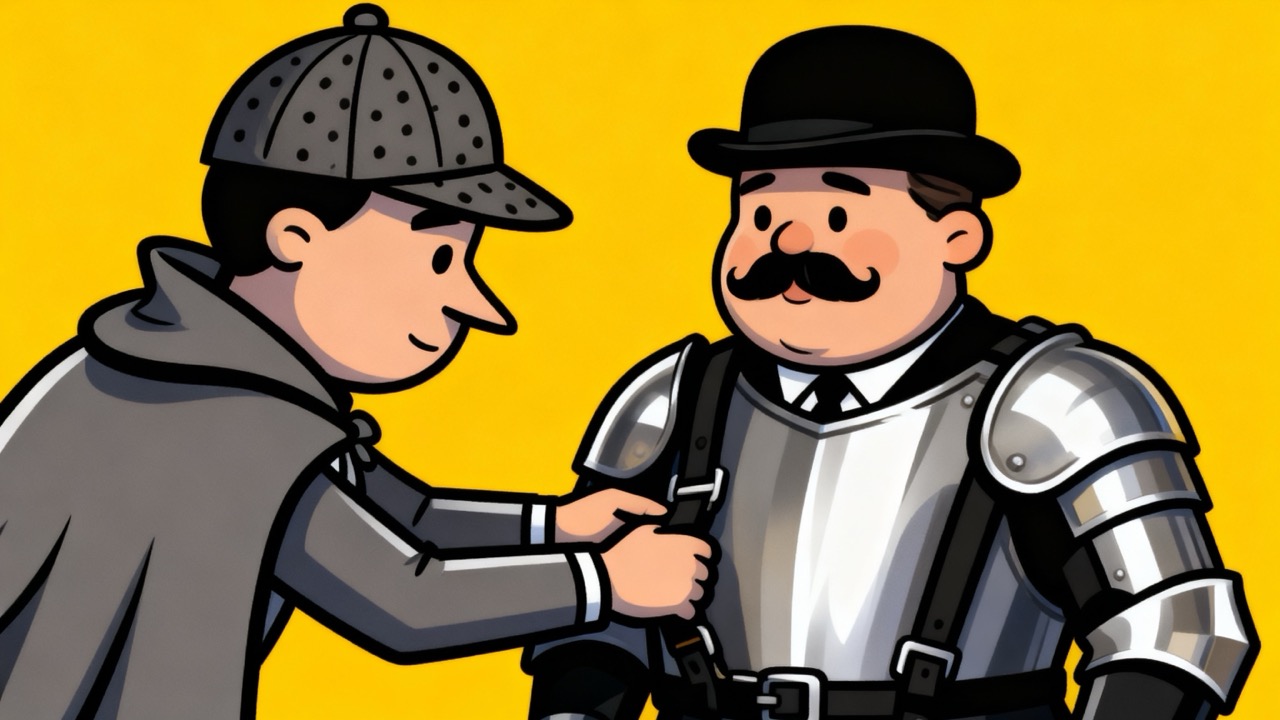
Hardening the prototype for enterprise use with security and accuracy quality control

Hardening

Once you're happy it's genuinely useful, we make it robust for an enterprise: proper security review if it's a software tool, rigorous accuracy and quality control if it's a dashboard, report or one-off deliverable. The prototype becomes something you can stake decisions on.

Done with you, or done for you

However hands-on you want to be, the choice is yours—and you're never locked in. We scope it together first, with no obligation, and you can change the balance as your team grows.

Done with you

We co-design the framework and set everything up alongside your team, then hand over the day-to-day. You own the running and the reporting; we stay on call for the harder questions. Best if you have analysts who want to own the work—but not start from scratch.

Done for you

We run the whole thing as a managed service—building your framework, analysing every channel, and delivering the reports your teams need. You consume the insight without carrying the workload. Best if you want the answers without adding to your team's plate, or while you build capacity.

What does a consultancy project cost?

Consultancy is priced by the value of the work, not by the hour—so every project is scoped with you up front. As a guide, engagements run from around £1,450 for a survey-design and framework review, to about £12,000 for a multi-month CX diagnosis and improvement programme. All prices exclude VAT.

Every engagement is different, so these are examples of the kinds of project we take on—and what they typically cost—rather than fixed packages. We scope yours with you, and price it on the value it delivers.

  • Programme design

    Design a VoC programme

    from £1,450

    Get the foundations right before you collect a thing.

    A focused design engagement

    • Review your survey design
    • Help you select analytical frameworks and methodologies
    • Shape a voice-of-customer programme that answers the questions you actually have
  • One-off analysis

    Analyse a dataset end-to-end

    around £7,750

    Turn a backlog of unstructured feedback into decisions.

    A one-off, full-stack analysis

    • Build categorisation models for your data
    • Analyse a large unstructured dataset
    • Build Power BI dashboards
    • Deliver a recommendations report
  • Outcome programme

    Diagnose & fix CX friction

    around £12,000

    Find your biggest friction points and move the metric.

    An outcome programme over 3–6 months

    • Diagnose your biggest CX issues and friction points
    • Implement a methodology to tackle them
    • Monitor the improvement over a 3–6 month period

Examples, not packages—every engagement is scoped to you and priced on the value it delivers, not the time it takes. Prices exclude VAT.

Customer stories

From stranded with data to a team that gets asked what to do next

Sovereign Housing got around ten hours a week back—time their team had been spending wrangling feedback by hand—after Wordnerds built and ran their classification with them. The partnership turned a manual reporting chore into a live picture their operational teams could act on, not a report that landed late and went unread.

The pattern repeats across the teams we work with. Before, feedback piles up faster than anyone can read it, and the insight team spends its days re-packaging the same data for different audiences instead of finding what matters.

Dorchester Collection started with us running the analysis as a managed service while their team got up to speed, then took the reporting in-house as their confidence grew—the framework was theirs to own from the start, not rented. We stayed alongside for the harder questions.

That's the shift the partnership buys: not just cleaner data, but an insight team that stops defending its numbers and starts being asked, every week, what the business should do next.

It's the move from tagger to strategist: a CX team that runs on customer evidence, trusted to shape decisions rather than just report them.

Questions teams ask before working with us

Does Wordnerds offer consultancy, or just software?

Wordnerds is software plus a Nerd-assisted consultancy—not a self-serve tool you're left to figure out. A team of experts co-designs your feedback classification, trains it to your sector, and supports your teams in using it. You can have that done with you or done for you, and adjust the balance over time.

What's the difference between done with you and done for you?

Done with you means we co-design and set up the framework alongside your team, then you own the day-to-day running while we stay on call. Done for you means we run it as a managed service—analysing every channel and delivering the reports—so you get the insight without the workload. Most customers move between the two as they grow.

Can't we just build this ourselves with AI or Copilot?

You can get part of the way—an AI model will summarise feedback and gauge rough sentiment. The hard part is everything after: consistent, auditable classification at scale, which gets expensive fast on raw AI, and the method to turn it into decisions. There's also the cost no one budgets for—the time spent maintaining, tuning and re-running a tool you built yourself, often to rebuild software that already exists. That method, and that maintenance, are what our experts carry, and what a prompt can't.

How is the consultancy different from just buying the platform?

They're one offering—software and a service. The Wordnerds platform stores, scales and delivers the intelligence into your Power BI; the consultancy is the team of experts who design the method, train it to your sector, and make sure it gets used. Most projects use both—the platform is the engine, the consultancy is what points it at the right problem. Some one-off projects never touch the platform at all.

Do you take on one-off projects, or only ongoing partnerships?

Both. Alongside the ongoing partnerships, we take on standalone consultancy projects—work that needn't touch the platform at all. We've designed bias-free public-consultation surveys, built to withstand legal challenge, for the North East Combined Authority, and built bespoke models that predict customer churn from complaints for a major UK bank. If a single hard question is the whole job, we can be hired to answer just that.

Are we locked in, or can we run it ourselves later?

You're never locked in. Many customers start with us running everything, then take more in-house as their team grows—the framework is yours to keep either way. We stay involved at whatever level suits you, from a full managed service to the occasional second opinion. Available when you want us, never mandated.

How much does a consultancy project cost?

It depends on the work, because we price on value rather than time—but we're happy to be specific. A survey-design and framework review starts from around £1,450; analysing a large unstructured dataset end-to-end into Power BI dashboards and a report is around £7,750; a 3–6 month CX diagnosis and improvement programme is around £12,000. We scope yours with you up front. All prices exclude VAT.

Two sides of Wordnerds

Software, a service—or both

You're looking at the consultancy—the team who run it with you or for you, including one-off projects. Prefer a platform your team runs day to day? That's the software—most customers use both.

Pete, founder of Wordnerds

So you're reading the footer now? Either you ❤️ Wordnerds or you're desperate for something to read. Either way, CX Corner from Wordnerds is the answer. Fortnightly Voice of Customer bombs dropped in your box. Signup 👇 or find out more.