Katie Kavanagh
Customer Success Executive — Wordnerds
Katie hosts the Wordnerds webinar series and chaired the session this playbook draws on.
A four-layer self-audit for UK CX and insight leaders. Spot which layers your current segmentation already covers, which it's missing, and what those gaps are quietly costing you.
Built from the Smart Segmentation session — Wordnerds' customer-success team and the British Red Cross's Voice of the Supporter lead.
Customer Success Executive — Wordnerds
Katie hosts the Wordnerds webinar series and chaired the session this playbook draws on.

Customer Success Manager — Wordnerds
Zoe walks through the four-layer framework with worked examples across transport (the effort framework), hospitality (luxury hotel motivations) and social housing (vulnerability flags as temporary states).

Senior Voice of the Supporter Manager — British Red Cross
Emma leads the Voice of the Supporter function at the British Red Cross. She brings the customer case study: how the British Red Cross built attitudinal and motivational segmentation, and the shared-language journey across teams.
Published · Last updated
Most customer segmentations stop at one layer — the easiest one.
Demographics describe who your customers are, but not why they act, and not what they actually want from you when something goes wrong. This playbook is a four-layer self-audit—Demographics, Behaviour, Attitudes, Motivations—designed to help you spot which of those layers your current segmentation already covers, which ones it's missing, and what those gaps are quietly costing you: the segments that look healthy but are silently churning, the campaigns that work brilliantly for half your audience and bounce off the other half, the board questions you can't yet answer because your data only goes one layer deep.
Read it through and you'll have a clear picture of where your segmentation isn't doing the work you need it to—and what kind of work would close the biggest gap.
Most do. Age, location, tenure, property type, income band—that's where most UK customer-insight operations plateau. It's not wrong. Demographics are the easiest data to collect and the easiest cut to explain to a board. They're just one layer of four.
If that's where you are, you're in plenty of company—and you probably already half-know it. The board asks why retention is moving in a segment your model doesn't really recognise. The campaign that worked brilliantly for half your audience bounces clean off the other half. A satisfied segment turns out to have been quietly churning for six months. Nothing's broken exactly. It's just that demographics describe who customers are without explaining why they act. The other three layers—Behaviour, Attitudes, Motivations—are where the why lives.
This is the trap we keep seeing: segmentation that ends up as reporting decoration—a colour on a chart, a row in a deck, a category that looks crisp on a slide but doesn't actually drive a different decision anywhere in the business. The four-layer framework in this playbook is what segmentation looks like when it stops decorating reports and starts shaping decisions.
Some sectors are already operating in those layers, often because their regulator has nudged them there. Ofgem commissioned GfK to build an attitudinal segmentation of energy consumers—not demographic, attitudinal—and published "golden questions" suppliers can use to place their own customers into segments. The Financial Conduct Authority's Consumer Duty treats behavioural data—what customers actually do—as primary evidence that firms are delivering good outcomes. The Housing Ombudsman frames tenant stigma as relational, not demographic—a stat from the G15 (London's largest housing associations) found 43% of residents say interactions with their landlord are the principal source of it. Different sectors, different reasons, same underlying move: out of Layer 1 and into the rest.
None of this is a case for throwing out the segmentation you've already built. Demographics are real, useful, and load-bearing where they connect to a service decision. The audit is about what happens when Layer 1 is asked to do work it can't—when the segments your team trusts are quietly hiding the variance the other three layers would show.
Four layers, in order: Layer 1—Demographics (who your customers are); Layer 2—Behaviour (what they actually do); Layer 3—Attitudes (how they think and feel); Layer 4—Motivations (why they act now). Each layer has the same shape: what it is, the evidence for why it matters, the specific red flags that tell you you're missing it, and one concrete next action you could start next week.
Smart segmentation stacks four layers: Demographics (who customers are), Behaviour (what they do), Attitudes (how they think and feel) and Motivations (why they act now). Each layer adds explanatory power the one below can't reach — together they show not just who churned, but why.

Demographics are Layer 1: the easiest to collect and the easiest to plateau on. The other three layers are where the why lives. Here's the whole model on one page before we work through it layer by layer.
Work through each layer in turn. For every one, a health check, the red flags to watch for, and a next action you can run this week — without a fresh research project.
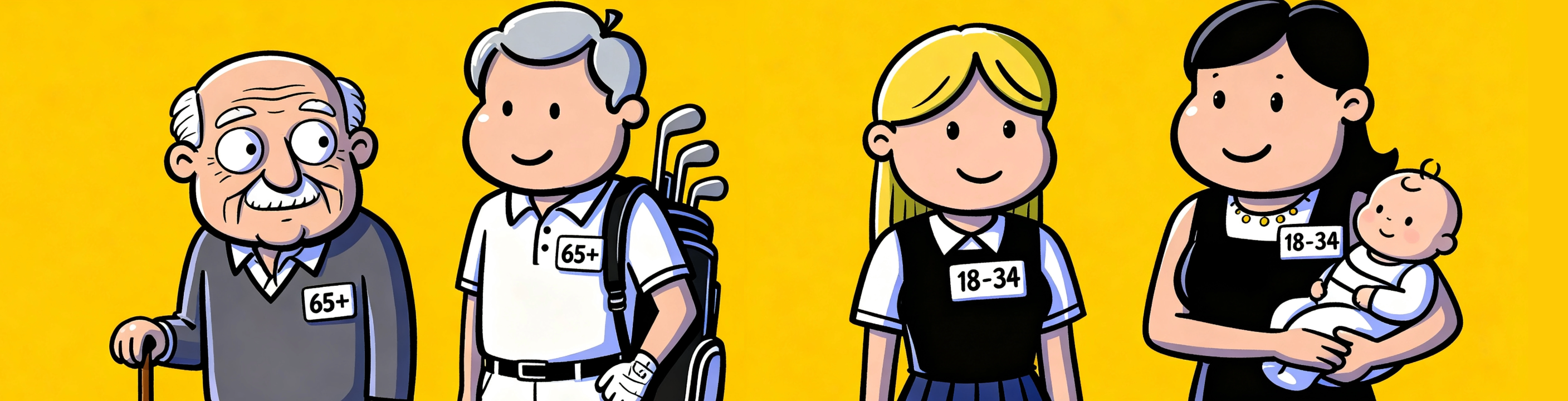
Demographics are the oldest layer of the four and the one with the longest administrative history. Those five-year age bands every UK research team defaults to (18–24, 25–34, 65+ and the rest) come from census convention—not because anyone ever proved that people inside a band share meaningful attitudes or behaviours. The 65+ threshold in particular is a pension-policy artefact dating to the Old Age Contributory Pensions Act 1925. Market research inherited the bands because they matched census denominators. We've been using them ever since because everybody else does.
Modern gerontology draws a sharper distinction than any census band does. It separates chronological age (years since birth), functional age (the physical, cognitive, and social capabilities someone actually has), and subjective age (how old a person feels and the identity they claim). For most CX-relevant outcomes—whether someone can use a self-service channel, whether they'll change provider, whether they'll complain when something goes wrong—functional and subjective age predict better than chronological age. Chronological age is the variable you have. The other two are the ones you want.
None of this means demographics are useless. Property type in housing genuinely drives different service experiences. Journey purpose in rail genuinely shapes satisfaction expectations. Income decile genuinely predicts tariff-plan fit. The trap is treating demographics as the primary axis of segmentation when the outcome you're trying to predict is behavioural, attitudinal, or about what a customer actually needs from your service.
Don't worry about ticking everything off—this is one layer of four, not a maturity scorecard. The more of these are true for you, the more confident you can be that demographics are doing real work, not just decorating reports:
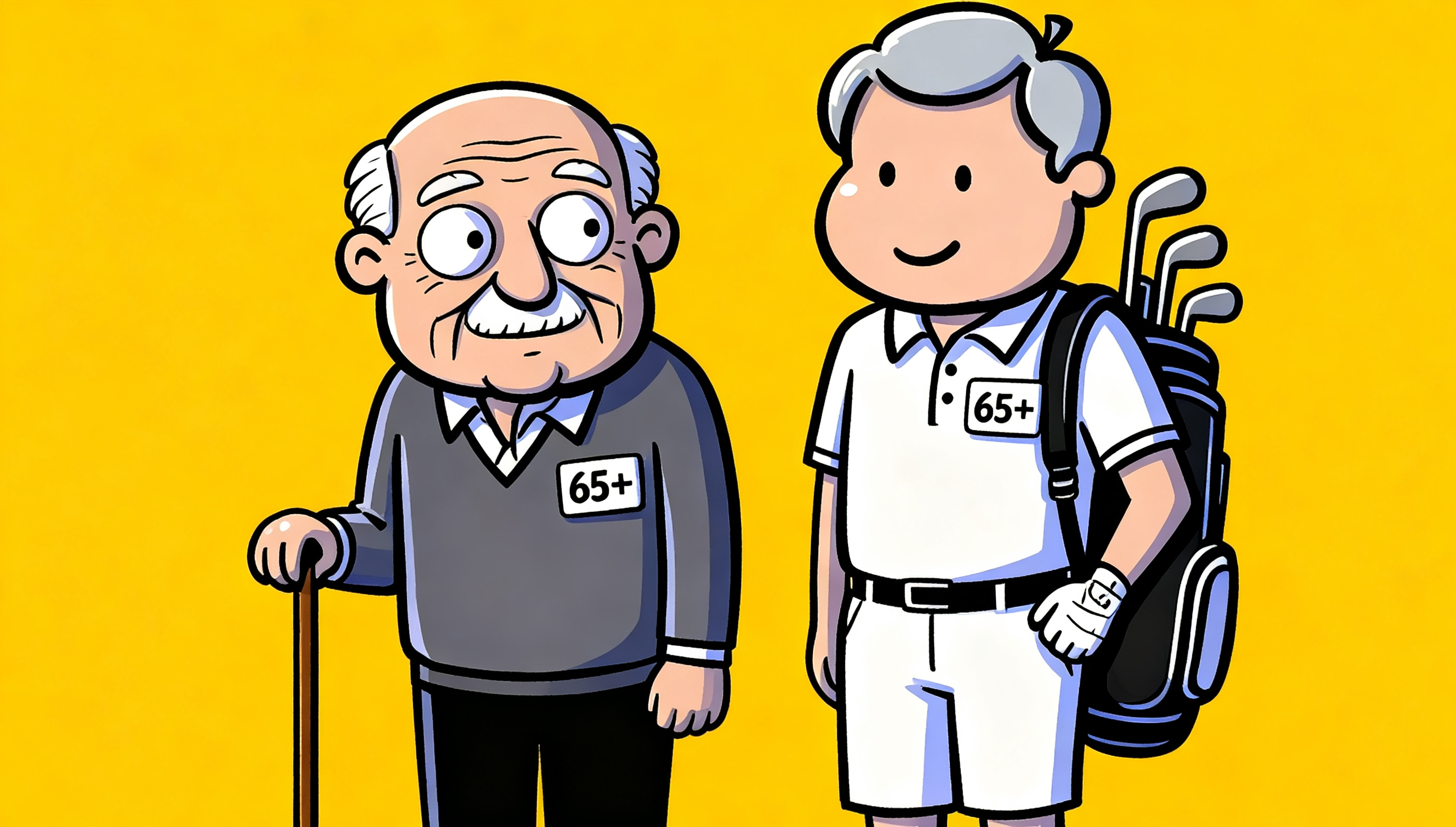
The "65+" trap is the clearest demographic-layer failure mode. Zoe captured this in the Smart Segmentation webinar: her newly-retired dad spends his days on the golf course and walks 10k a day. Her 91-year-old gran watches golf from the sofa and wanders a hundred metres down the street to say hello to her neighbours. Same age band. Completely different people, with completely different service needs.
The bigger picture lines up with what Zoe described. The English Longitudinal Study of Ageing—a long-running UK study tracking people aged 50+—shows that within any five-year cohort above 65, people sit at very different points on cognition, self-rated health, day-to-day capability, and wealth. The spread inside a band overlaps almost entirely with the bands either side of it. ONS healthy-life-expectancy data lands the same point: the gap between the most and least deprived English regions, just within the over-65s, is wider than the average difference between adjacent five-year age bands. In practical terms: two of your "65–74" customers can need genuinely different things from you, and the band on its own won't tell you which is which.
The Housing Learning and Improvement Network has argued for over a decade that designing services around age thresholds gets it wrong in both directions at once. On one side, plenty of over-65s in general-needs housing have functional needs—mobility, cognition, isolation—that the standard service model wasn't built to spot. On the other, plenty of residents in age-designated older-person schemes are fitter, more independent, and more digitally confident than the support model assumes. Both groups end up in the wrong service for them.
The critique isn't 65+-specific. Even the standard 10-year bands hide a lot. The 25–34 band collapses students finishing courses, early-career renters in shared housing, young parents, and first-time buyers into one unit. The 45–54 band stretches from school-age parents to empty-nesters, peak-earning to redundancy, mortgage-paying to mortgage-free.
If your segmentation uses age bands as a primary axis for predicting behavioural or attitudinal outcomes, the variation inside the bands is very likely doing more predictive work than the difference between them. And you can't see it because you're looking at the average.
Pick a demographic segment your team treats as fairly uniform—an age band, a tenure type, an income band, a property type, whatever's currently load-bearing in your segmentation. Then test the assumption a couple of ways:

Behavioural segmentation classifies customers by what they actually do: what they bought, how often, through which channel, how they engaged with communications, how they complained, how long they stayed. In our work with feedback teams across various industries—including housing, utilities, retail, finance, travel, and hospitality—this is the layer most organisations already have the data for, and the layer they most systematically underuse.
A handful of well-established frameworks underpin it: RFM (Recency, Frequency, Monetary value), refined from 1960s–70s direct marketing into probability models that estimate who's about to come back, who's drifting, and who's already lost; engagement cohort analysis, borrowed from SaaS, which groups customers by when they first engaged and tracks how engagement decays; CLV tiering, which segments by predicted customer lifetime value; and unsupervised clustering, where you let the model surface the natural groupings in the data rather than imposing them.
What they all have in common: they need transactional or interaction data your organisation almost certainly already has. That's why this layer is high-volume, continuously updating, and nearly free for anyone already running operational systems—it sits usefully between demographics (stable, low-resolution) and attitudes (high-resolution, drawn from surveys and open-text feedback, complaints, contact-centre transcripts, and chat logs).
Most teams we talk to spot themselves on this list somewhere partway down, not all the way at the bottom—so don't sweat full ticks. Look for direction of travel rather than perfection:
Behavioural-only segmentation hits a ceiling—and most teams discover it on their own data, the hard way. The first half of the journey is genuinely useful: across marketing, banking, and telecoms, models built on what customers do (their transactions, their channel choices, their complaint patterns) predict churn and retention by a meaningful margin over models built on who they are. So far, so good.
Then it stops improving. You can keep adding behavioural features—new channels, new transaction types, more granular usage data—and the model just doesn't sharpen. The temptation at this point is to throw more behavioural data at the problem; it rarely helps. Worse, it's the moment behavioural segmentation drifts into reporting decoration—still on the slide, still being refreshed quarterly, no longer driving anything new.
The ceiling has a specific shape. Two customers can look identical on every behavioural measure you have—same transactions, same frequency, same channels—and end up on completely different satisfaction, advocacy, and churn paths. Two bank customers with identical RFM scores can hold radically different levels of trust in the institution. Two tenants with identical repair-request frequency can have opposite satisfaction trajectories. Behaviour explains a lot, but it stops explaining at the moment two people behave the same way for completely different reasons.
Some regulators are already working through this in real time. The FCA's Consumer Duty treats behavioural data—product switching, complaint rates, arrears emergence—as primary evidence of customer outcomes, while explicitly acknowledging that behaviour is a limited proxy for vulnerability. Ofgem does similar with energy customers but has documented that behavioural-only proxies systematically miss customers whose circumstances have changed without their behaviour catching up yet.
It produces two characteristic mistakes:
Pick a behavioural segment your model treats as homogeneous—your "high-churn-risk" group, your "engaged" group, your "lapsing" group, whichever is currently load-bearing for you. Then look inside it:

Attitudinal segmentation is where the predictive ceiling of Layer 2 gets broken. Values, worldviews, emotional associations, beliefs about the sector, trust in the provider—the stable dispositions that explain why two customers who look identical on every demographic and every behavioural measure end up on opposite satisfaction trajectories. This is also—we'd argue, biased as we obviously are—the layer where the stuff customers say in their own words starts pulling its weight.
There's a long-standing tradition in UK research—from Values Modes through Schwartz's basic values to NatCen's British Social Attitudes survey—that takes attitudes seriously as a way of understanding people. They differ in scope, method, and audience, but they share an underlying claim: attitudes, values, and beliefs vary systematically within populations that look uniform on demographic data, and that variation is measurable, stable enough to act on, and meaningfully independent of demographics. That's why a tenure- or age-based segmentation can never approximate an attitudinal one.
This is the layer most CX teams have least of, so the bar here is genuinely lower than the others. Even rough early progress counts:
The most common red flag is the "everyone in my sector wants the same thing" objection. We heard it directly during the Smart Segmentation webinar: if customers in a regulated sector all need the same functional thing—affordable housing, gas supply, punctual trains—can attitudinal segmentation meaningfully differentiate them? The evidence says yes. And in regulated sectors, the regulators are doing it already.
Ofgem commissioned GfK in 2017 to build an attitudinal segmentation of energy consumers "to help better understand consumers' underlying barriers to and drivers of engagement," and published "golden questions" so suppliers, consumer bodies, and downstream researchers could place their own customers into the segments. Alongside, the Centre for Sustainable Energy maintains a set of 24 consumer archetypes, explicitly designed to surface vulnerable consumers whom a pure income-decile cut would miss.
Ofwat frames affordability uptake in explicitly attitudinal terms. The regulator notes that only a third of bill payers know financial support is available, and that customers in vulnerable circumstances are "often unlikely to reach out for support, which could be because of feelings of shame, denial or helplessness." Shame, denial, helplessness—attitudes, not demographic attributes. Two customers with identical income, household composition, and region can sit at very different points on that axis.
Housing is the sector with the most visible attitudinal gap. The Housing Ombudsman's severe maladministration reports consistently frame the core failure as one of attitude and communication rather than technical performance. Research from London's largest housing associations found 43% of residents identified interactions with their landlord as the principal source of stigma. The framework is mature and UK-native; the sector hasn't applied it yet.
The shorter version: in regulated sectors, the regulators have already broken ground on the attitudinal layer. Whether you're inside a regulated sector or not, the same principle holds: any population that looks uniform on demographics and behaviour is hiding meaningful attitudinal variation that you can only see if you go looking for it.
You don't need a fresh research project to start exploring this layer. The substrate is whatever customer-language you already have—open-text survey responses, complaint narratives, contact-centre notes, chat logs. The exercise is to read through a batch of it with attitudinal patterns in mind: trust, fairness, control, dignity, hope, frustration. Where do those repeat? Where do they cluster? Where do you find variation you weren't expecting?
If you're in a sector where the regulator has already done foundational attitudinal work—energy, water, housing—their published material can sit alongside your own data as a useful reference point.
The aim isn't a finished segmentation in week one. It's noticing that the variation your demographic cuts can't see is already in your data, written in your customers' own words.

Where attitudes describe stable dispositions, motivations describe the reason someone acts in this moment. Motivations shift with life events, news cycles, service incidents, and how salient a particular concern feels today. A customer whose attitudes haven't budged in five years can have a motivational profile that moves week to week. This is the layer where the question stops being "who is this customer?" and becomes "what are they trying to do right now?"
There's a body of well-known business and marketing literature on what motivates customers to act—different lenses for different sectors—and most CX leaders have come across at least some of it. The point we want to make here isn't which lens. It's that the right one for your sector is usually different from the one for someone else's sector, and the metric you're using right now might be pointing at the wrong thing for your customers altogether.
Hardly anyone has all of this in place. Realistically, this is the layer where you're aiming to do some of it on purpose rather than zero of it by accident:
The clearest motivational-layer failure mode is the one-size-fits-all CX metric trap: using the same headline metric (NPS, CSAT, sometimes both) across sectors whose customers are motivated by completely different things. You end up with noise where you should be getting signal, and you can't always work out why.
Different sectors don't all motivate the same way. Some are about minimising friction—getting somewhere on time, resolving a problem quickly, finding what you needed without effort. Some are about quality of experience—memorability, personal engagement, the feeling of being valued. Plenty of sectors sit somewhere in between, where reliability is the baseline and how customers feel treated when something goes wrong is the bit that drives loyalty.
UK regulated sectors illustrate the range. UK rail's measurement apparatus—Transport Focus's National Rail Passenger Survey and the ORR's Rail User Survey—reflects the friction-minimising end. The Regulator of Social Housing's Tenant Satisfaction Measures reflect the in-between zone—12 measures that span both the transactional (repairs, safety) and the explicitly relational (keeping tenants informed, treating fairly and with respect, listening and acting on views, handling complaints).
The red flag to look for in your own organisation: if your sector sits in the in-between zone but you're measuring it with a single friction-dominant metric (NPS or CES on its own), you'll be measuring the reliability half reasonably well and missing the dignity-fairness-voice piece almost entirely. That's the half that drives complaint escalation in housing and regulated utilities. Customers tolerate a fair amount of imperfection if the handling feels fair. If your segmentation doesn't surface that, you're measuring the wrong thing for your sector.
Try one of these:
Running a four-layer audit is useful in its own right. The much bigger return only shows up when segmentation stops being something one team owns and starts being the framework that every team makes its decisions inside—from deliverable to infrastructure.
The change that compounds isn't technical—it's in how people talk about customers, in meetings, in briefs, in handovers. Six months from now, here's what changes once segmentation is doing real work:
The board asks why retention is moving in a particular segment, and you can answer the question instead of caveating it. The segment explains the movement, not just describes it.
Marketing and service stop arguing about which group needs what. Both sides are using the same segment names for the same people, and disagreements become about strategy, not definitions.
The complaint pattern that used to surprise you is now one of the early-warning signals you actively watch. A "satisfied" group that quietly churned out from under you last year doesn't quietly churn this year—because you've stopped trusting "satisfied" as a single category.
When you make a campaign decision, an investment decision, a service-design decision, the audience rationale is legible to everyone in the room. We're spending this on these people for this reason. Defensible because it's documented, not because someone senior insisted on it.
When demographics, behaviours, attitudes, and people's own words come together in one framework, segmentation stops being about categorising people and starts being about understanding them—what they need, what they want, and what your organisation can actually help them with. It stops being reporting decoration and becomes part of how decisions get made every day.
People don't disappear into averages.
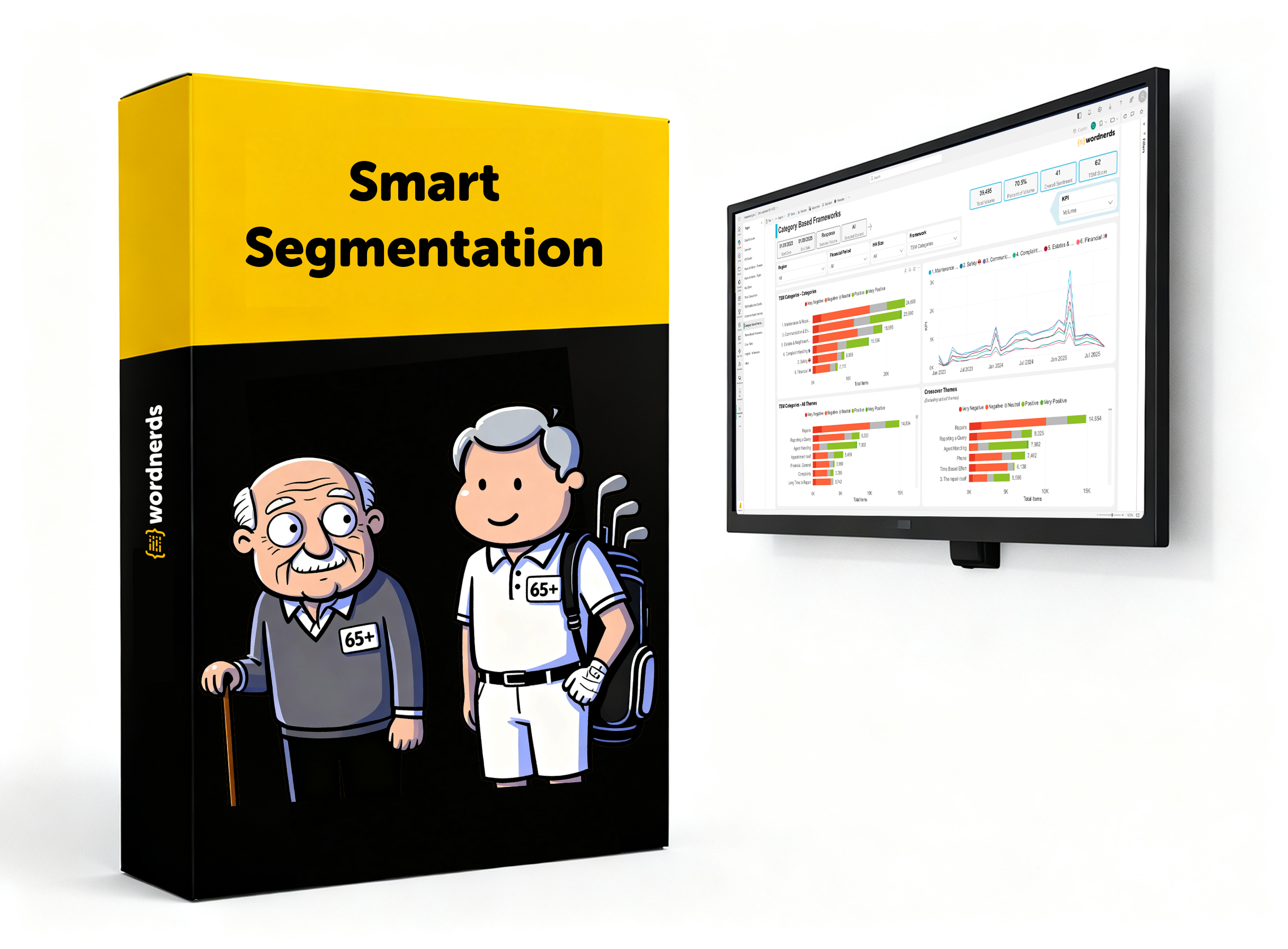
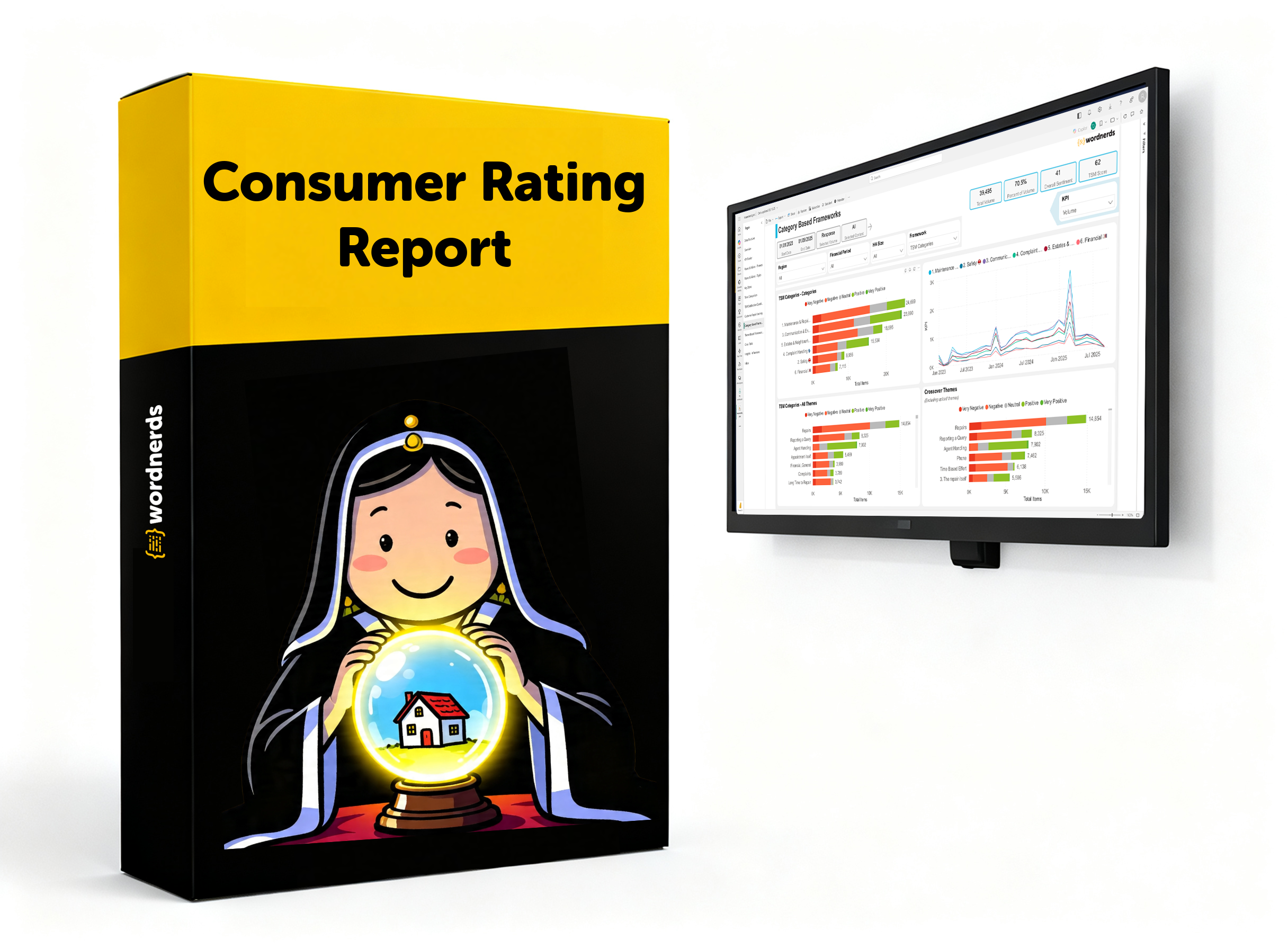
We work with the customer feedback you already have—open-text survey responses, contact-centre transcripts, complaints, chat logs—and run the four-layer framework against it. In 30 days, you get a clear picture of what each layer shows in your data, plus the artefacts to keep using afterwards.
A written deliverable that walks through what each of the four layers shows in your data, with segments, evidence, and recommendations.
Specific findings we go deeper on—either across layers (e.g. an attitudinal segment showing up in your behavioural data) or within a single layer. Got a question you've been wanting to answer? "Why does Segment X churn at twice the rate of Segment Y?" Those count too.
The themes we surfaced in your data, in a format your team can keep using as new feedback flows in—the segmentation stays current without us in the room.
Live, interactive, and yours to keep. Your team can carry on cutting and watching the segments after we hand over.
We sit down together, walk through the findings, and embed the work in the people who'll use it day-to-day. The dashboard makes the segmentation discoverable; the workshop makes it operational.
Your report is delivered by Wordnerds' Insight & Innovation and account team — the people who dig into your data, build the segmentation, and walk you through what they find.

Account Manager — Wordnerds
Your main point of contact, keeping the engagement on track from kickoff to handover.

Head of Account Management — Wordnerds
Oversees the account team and makes sure the findings land with your people.

Co-founder & Head of I&I — Wordnerds
Leads Insight & Innovation, setting the analytical approach for your four-layer analysis.

Innovation Manager — Wordnerds
Shapes how the segmentation is built and turned into something your team can use.

Data Analyst — Wordnerds
Runs the analysis across your feedback data, surfacing the segments and the themes behind them.
Layered customer segmentation stacks four layers of understanding instead of relying on one. Demographics describe who customers are; behaviour, what they do; attitudes, how they think and feel; and motivations, why they act now. Each layer explains variation the layer below can't see — so a single demographic group splits into genuinely different people once you read the other three layers.
Demographics are the easiest data to collect and explain, but they describe who customers are without explaining why they act. Two people in the same age band, income bracket or property type can need completely different things from you. When the outcome you're predicting is behavioural or attitudinal, the variation inside a demographic band usually does more predictive work than the difference between bands — and a demographic cut can't see it.
Attitudinal segmentation groups customers by values, beliefs, trust and emotional associations — the stable dispositions that explain why two customers who look identical on demographics and behaviour end up on opposite satisfaction paths. It's where customers' own words pull their weight: open-text feedback, complaints and contact-centre transcripts carry the attitudes a tick-box survey misses. Regulators including Ofgem and Ofwat already segment their sectors this way.
Motivational segmentation captures why a customer acts right now — the reason that shifts with life events, incidents and how salient a concern feels today. Where attitudes are stable, motivations move week to week. It matters because a single headline metric like NPS or CSAT often measures the wrong thing for your sector: friction-minimising and experience-led sectors are motivated by different things, and a one-size metric misses the dignity, fairness and voice that actually drive loyalty.
The British Red Cross's Voice of the Supporter team built attitudinal and motivational segmentation from supporters' own words, then made the segment names shared across teams — so marketing, service and insight describe the same people the same way. The shift that mattered wasn't technical: segmentation moved from one team's deliverable to the common language every team makes decisions inside.
Register your interest and a specialist will be in touch within two working days to talk through your data and what the analysis would surface.
Tell us a little about your data and a specialist will be in touch within two working days to talk through what the analysis would surface.

So you're reading the footer now? Either you ❤️ Wordnerds or you're desperate for something to read. Either way, CX Corner from Wordnerds is the answer. Fortnightly Voice of Customer bombs dropped in your box. Signup 👇 or find out more.